HOUND
A full-stack ride-hailing platform built for an all-electric fleet. A rider app with live tracking and eco-credits, a driver app with range-aware job allocation and charging-station routing, and a real-time dispatch console for fleet health. The goal: match the big apps on product quality, then win on the thing they can't switch on overnight.
Three surfaces, one live fleet.
A rider app, a driver app and a dispatch console — sharing one data model and one live source of location and battery data.
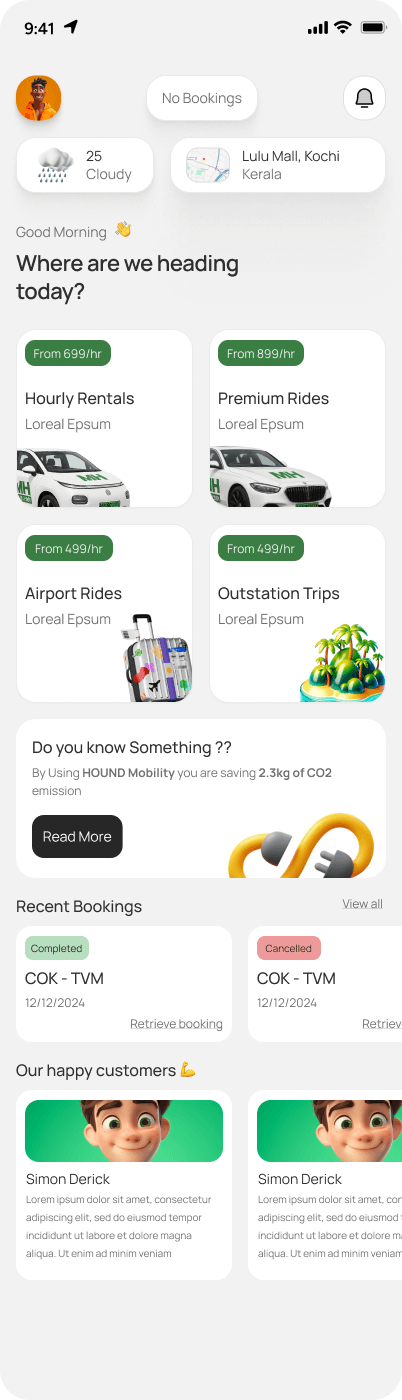
The rider sees a car approaching and an ETA they can trust. The driver gets earnings up front and charging stops before the battery gets anxious. The dispatcher watches the whole fleet on one screen. Each surface is designed for its own user — joined underneath by shared, real-time data.
Real-time EV tracking, eco-credits, fare estimates by vehicle type.
Range-aware job dispatch, charging station alerts, earnings dashboard.
Full fleet view, active ride monitoring, driver onboarding, analytics.
Compete with Uber on product. Win on sustainability.
Ride-hailing is owned by giants with a decade of product work and billions in the bank. You don't out-spend that, and you don't out-discount it either. Hound's brief was honest about the maths: match the product quality people already expect from the big apps, then win on the one thing the incumbents can't switch on overnight — an all-electric fleet.
Electric wasn't the marketing line; it was the constraint that shaped everything. A driver can't accept a fare that would strand them at 4%. A rider needs to believe the car won't quietly die on the motorway. So range and charging couldn't be a badge bolted on at the end. They had to sit underneath the routing, the dispatch logic and the rider's ETA.
Then dispatch. A small ops team needed the kind of live picture a major fleet operator takes for granted — every driver's location, every battery level, every active ride — on one screen legible enough that nobody needs an analyst to translate it during a busy Friday night.
What was hard: three real-time surfaces all leaning on the same live location and battery data is a lot of moving parts for one build window, and every one of them breaks in a different way when the data hiccups. We made a deliberate call to nail the rider and driver apps first and ship the dispatch console with a focused, opinionated feature set rather than every report an operator might someday ask for. If we ran it again, we'd lock the charging-station data source down in week one. Stitching together a reliable, current map of where you can actually charge ate far more time than the brief implied — the EV world is still messier than the apps make it look.
What we set out to solve.
Four convictions about EV ride-hailing — each one shaped how the three surfaces behave.
An EV fleet can't pretend battery doesn't exist. We treated range, charge level, and charging stops as core data the whole product is built around — not numbers hidden three taps deep.
Riders cancel when they can't tell what's happening. Our bet was that clear, live tracking and an honest ETA would keep people in the ride rather than reaching for the cancel button.
Driver apps tend to treat drivers as something to be managed. We designed the driver app to show earnings plainly and surface charging stops before they become a problem.
Going electric only matters if it shows up in the experience. Eco-credits and an all-EV fleet were built to be functional and worth mentioning, not a sticker on the login screen.
How we built it.
Five weeks, four phases — three real-time surfaces built on one shared, battery-aware data model.
DISCOVERY & FLEET ARCHITECTURE
Three people use this product and they want different things. The rider wants to get somewhere without thinking about the car. The driver wants to earn without babysitting an algorithm. The dispatcher wants the whole fleet on one screen. We designed each surface for its own user and let a shared data model do the joining underneath. The EV constraint ran through all three: range, charge and charging stops were structural from day one, because retrofitting battery awareness into a finished routing system is a rebuild, not a patch.
RIDER APP
The rider app is really about confidence. You watch your driver approach, you trust the ETA, and the thought "will this thing actually make it?" never gets the chance to form. Live tracking and a visible range indicator carry most of that. Eco-credits that build toward real discounts turn the electric choice into something a rider feels in their account, not a slogan on the splash screen.
DRIVER APP
Most driver apps treat the driver as a resource to optimise. We aimed the other way. Earnings sit front and centre, charging stations surface before the battery gets anxious, and the matching engine weighs remaining range, not just raw distance, so nobody gets handed a fare that ends with them stranded ten miles from a charger. The trick was telling a driver how they're doing without burying them in pings — the app speaks up when it matters and shuts up the rest of the time.
DISPATCH CONSOLE & FLEET MANAGEMENT
The dispatch console puts the whole fleet on one screen: where every driver is, how much charge is left in each car, which rides are live, and where demand is starting to bunch up. The goal was to hand a small ops team the visibility a big operator pays a department for, without anyone needing to be an analyst to read it. We also folded driver onboarding into the same place — document upload, background-check integration and vehicle registration in one flow instead of a paper trail that takes a week.
What we delivered.
Three connected surfaces, electric-first to the core, handed over with full IP — launched on schedule.
Rider app, driver app, and a real-time dispatch console — three products sharing one data model, one design system, and one live source of location and battery data.
Range, charge level, and charging stops are built into the core of every surface. Jobs are matched by remaining range, not just distance, so drivers don't get handed fares they can't finish.
The console puts driver locations, battery health, and active rides on a single screen — designed so a small operations team can run it without a data analyst on hand.
Complete ownership transferred on delivery: source, Figma files, and the design system. Launched on schedule with everything the client needed to keep building.