DINO
A two-sided platform: diners browse restaurants, book a table, pre-order by dish and flag allergens, while operators get a live table grid, guest management and a kitchen feed for the pre-orders. Built around the three things every other booking tool leaves half-solved — no-shows, pre-ordering and allergen tracking.
Two surfaces, one live booking.
A consumer-grade diner app and an operator dashboard that stay in lockstep — the same reservation, seen two ways.
Live table grid with guest details, allergen flags, and pre-order status visible before each party walks in.
Restaurant discovery, table booking, food pre-ordering, allergen flagging.
Live table grid, guest profiles, incoming pre-orders, allergen alerts.
Pre-orders arrive as structured kitchen tickets ahead of the booking.
A problem everyone knows how to fix, and almost nobody fixes well.
The no-show problem isn't a mystery. When a booking costs nothing to break, some people break it, and an empty table at 8pm on a Friday is money the kitchen already bought ingredients for. A small deposit fixes the maths. The mechanism has existed for years; most booking tools just skip it, or bolt it on so awkwardly that restaurants switch it straight back off.
Dino's founder came to us with a sharper version of the complaint: the big platforms nail the booking and ignore everything wrapped around it. Diners still recite their allergies to a waiter at the table. Pre-ordering barely exists. And a surprising number of venues still run the floor off a paper diary or a spreadsheet someone last tidied up in 2019.
So the brief was two products at once, not one with a back office bolted on. A diner app that holds its own against any consumer app on the phone, and a dashboard a floor manager can grab mid-service and understand without anyone standing over their shoulder.
What was hard: building two sides at once means every feature is really two — what the diner taps and what the venue sees, kept in sync without a beat of lag. We could have saved time with one shared interface stretched across both users. We didn't, because a floor manager mid-service and a diner on the sofa want opposite things. The part we genuinely underestimated was the kitchen: turning a pre-order into a ticket a slammed kitchen actually trusts took more rounds than we'd planned. A clean data feed isn't the same as a feed the pass believes.
What we set out to solve.
Four convictions about where booking tools fall down — each one shaped a decision in the product.
When there's no money on the line, some diners just don't turn up. A small deposit changes that calculus. The fix exists — most booking tools either skip it or bolt it on awkwardly.
Letting guests choose food before they arrive cuts the wait and lifts the bill. Almost no booking platform does it well, so we made it a first-class part of the flow.
Allergen info passed verbally at the door is a legal and safety hazard. Capturing it digitally, per dish, before the kitchen starts prep was non-negotiable for us.
Plenty of venues still run the floor from a paper diary or an ancient spreadsheet. No live view, no guest history. The dashboard had to be better than the diary on day one, or nobody switches.
How we built it.
Five weeks, four phases — from mapping both journeys to a self-serve launch.
DISCOVERY & SPRINT 0
We mapped both journeys end to end: the diner finding a place, booking, pre-ordering and arriving, and the venue taking that booking, working the floor and prepping the pass. Both sides kept describing the same wound in different words — by the time the information arrived, it was already too late to use. That became the whole brief. Get the right detail to the right person while they can still act on it.
DINER APP — BOOKING & PRE-ORDER
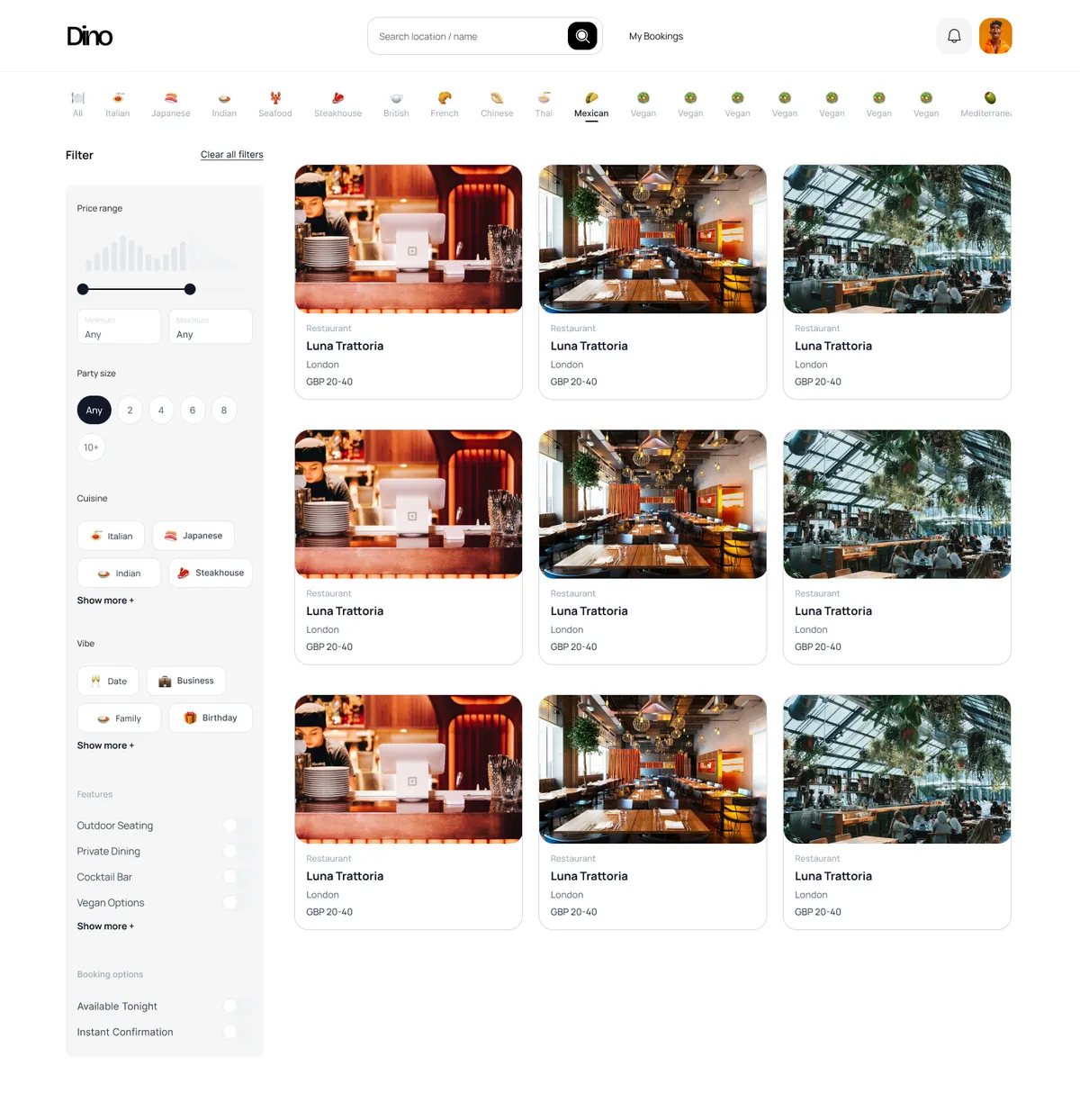
The diner app does three things together that most apps don't do even one of well: real availability, pre-order by dish, and allergens captured per dish. It all happens in a single sitting — find a place, pick a time, set the party size, choose food, flag the nut allergy, done. We fought hard to keep that flow short. Every extra screen is a chance to put the phone down, and a booking abandoned halfway is just a no-show that happens earlier.
RESTAURANT DASHBOARD
The venue side is a live table grid you can read at a glance — colour-coded by status, with guest profiles, allergen flags and incoming pre-orders one tap away. The piece we're proudest of is the kitchen link. Pre-orders land as structured tickets ahead of the booking instead of a scribble shouted across the pass, so the kitchen knows what's coming and what to leave off the plate before the doors even open. The detail that took the most care was the allergen flag: loud enough that nobody misses it, never so loud that it cries wolf.
LAUNCH & OPERATOR ONBOARDING
Onboarding is self-serve by design: a manager can upload a menu, lay out the tables and add their team without a sales call or a training day. Restaurants don't have a spare afternoon for setup, so setup had to fit in the gaps of a shift. It shipped with Stripe-connected deposits (the simplest honest way to deter no-shows), automated reminders, and a plain-English view of covers, revenue per table and no-shows by night — numbers an owner reads in ten seconds, not a BI tool they'll never open.
What we delivered.
One two-sided product, shipped end to end — booking, pre-order, allergens and deposits, all in sync.
A consumer-grade diner app and an operator dashboard that stay in sync — same booking, two views, each designed for the person using it rather than forced into one shared screen.
Deposit-backed reservations and automated reminders, built in from the start as the simplest honest way to stop no-shows — not bolted on after the fact.
Diners pick dishes and flag allergens during booking. Those orders flow straight to the kitchen as structured tickets, so prep can start before the guest sits down.
Allergen data is collected at booking and surfaced to the kitchen before service — replacing the verbal-at-the-door handoff that every operator we spoke to worried about.